Why Some Kids Talk Late and How to Support Their Speech Development
Updated: May 13, 2026 · 6 Minute Read

Reviewed by:
Emily Rourke, OTD, OTR/L
Highlights
- Every child develops at their own pace, but when your toddler isn’t talking as expected, it’s natural to feel concerned
- Sessions often include parent coaching so you can carry over techniques at home
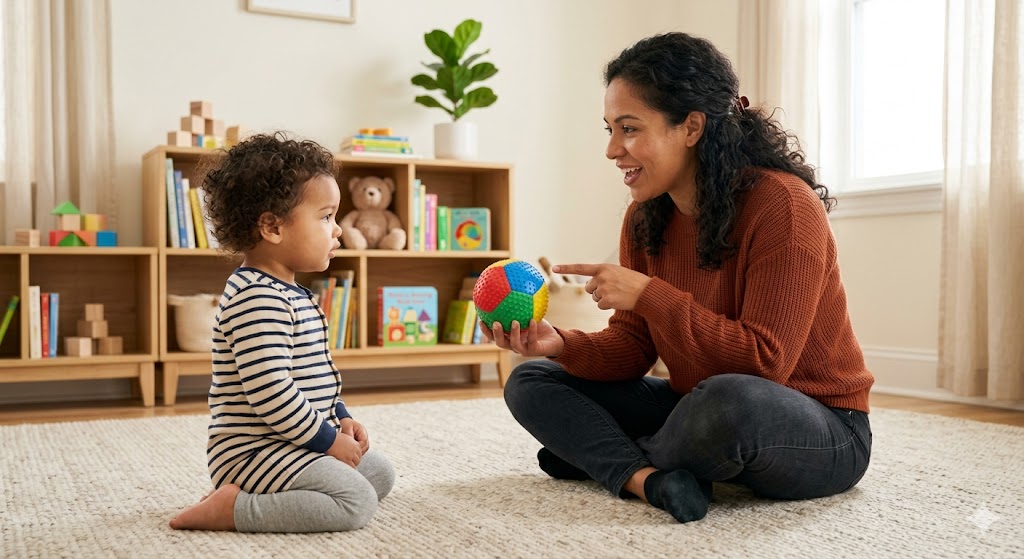
- The most powerful way to support speech is through meaningful interaction
Introduction
Every child develops at their own pace, but when your toddler isn’t talking as expected, it’s natural to feel concerned. While some children simply develop language later than others, delayed speech can also signal the need for extra support. The good news is that early identification and targeted intervention can make a big difference in helping your child catch up.
In this article, we’ll explore the possible reasons some children talk later than their peers, the early signs to watch for, and practical steps parents can take to support speech development at home and through professional services.
1. What Is a “Late Talker”?
A late talker is a child between 18 and 30 months who has a limited vocabulary for their age but is otherwise developing typically in areas like play, motor skills, and understanding of language.
Examples of speech delays may include:
- Fewer than 50 words by age 2
- No word combinations by 2.5 years
- Lack of gestures or difficulty imitating sounds
- Difficulty being understood by caregivers or peers
It’s important to differentiate between a “late bloomer” and a child with a speech or language disorder. Early evaluation can help clarify the difference and guide the right support.
2. What Are the Common Reasons Kids Talk Late?
There are many possible explanations for delayed speech, including:
1. Family History
Speech and language delays often run in families. If a parent or sibling talked late, your child may follow a similar pattern.
2. Hearing Issues
Even mild or temporary hearing loss (due to ear infections, for example) can impact how a child hears and processes sounds during critical speech development periods.
3. Developmental Differences
Some children with speech delays have underlying developmental conditions such as:
- Autism spectrum disorder (ASD)
- Intellectual disability
- Childhood apraxia of speech (a motor planning disorder)
- Global developmental delay
4. Environmental Factors
Limited verbal interaction or exposure to language-rich environments can delay speech. This might include too much passive screen time or limited opportunities for back-and-forth conversation.
5. Bilingualism
Being raised in a bilingual home can temporarily slow early speech milestones. However, this is not considered a delay unless the child is significantly behind in both languages.
3. How Can Parents Support Speech Development at Home?
The most powerful way to support speech is through meaningful interaction. Try these strategies:
1. Talk Throughout the Day
Narrate your actions during everyday tasks like cooking, cleaning, or getting dressed. Use simple, clear language: “Let’s wash hands. Turn on the water. Soap on.”
2. Pause and Wait
Give your child time to respond during interactions. Pause after asking a question or making a comment, and wait expectantly.
3. Use Repetition
Repeat key words and phrases often. For example: “Ball. Big ball. Red ball. Throw the ball.”
4. Expand on What They Say
If your child says “car,” respond with “Yes, that’s a blue car!”
5. Read Together
Books with repetition, rhyme, and simple pictures are best. Ask questions like “What’s this?” and point to images.
6. Reduce Screen Time
Limit passive screen use, which doesn’t support language learning as well as face-to-face interaction.
7. Use Gestures
Pointing, waving, and other gestures help support understanding and encourage communication.
4. When Should Parents Seek Professional Help?
You should talk to your pediatrician or a speech-language pathologist if your child:
- Is not babbling by 12 months
- Has fewer than 10 words by 18 months
- Has fewer than 50 words or isn’t combining words by 24–30 months
- Is difficult for familiar people to understand
- Doesn’t respond to their name or follow simple instructions
- Seems frustrated when trying to communicate
Early Intervention programs offer free or low-cost developmental evaluations for children under 3. A referral can come from your pediatrician or you can contact your state’s Early Intervention system directly.
5. What Does Speech Therapy for Late Talkers Look Like?
Speech therapy is personalized to your child’s needs. For toddlers, sessions are play-based and focused on:
- Expanding vocabulary
- Improving sound production
- Increasing sentence length
- Strengthening social communication
- Supporting parents with strategies for daily routines
Therapists may use picture books, toys, gestures, signs, or visuals to support communication.
Sessions often include parent coaching so you can carry over techniques at home. This consistency helps your child make faster progress.
6. Real-Life Example
Emma, age 2.5, used fewer than 20 words and became frustrated during play. Her parents contacted Early Intervention and began in-home speech therapy. With weekly sessions and daily language modeling at home, she began combining two words within two months and had over 100 words by her third birthday.
7. Conclusion
Some kids talk later than others, and in many cases, they catch up with support and time. Still, trust your instincts. If you’re concerned about your child’s speech, don’t wait. Early support can improve communication, reduce frustration, and lay a strong foundation for learning and connection.
By using simple strategies, engaging in everyday interactions, and seeking professional help when needed, you can empower your child to find their voice and thrive.
Find pediatric speech & occupational therapy, covered by insurance.


Article References
- American Speech-Language-Hearing Association (ASHA). (2023). Typical Speech and Language Development.
- Zubrick, S. R., Taylor, C. L., Rice, M. L., & Slegers, D. W. (2007). Late language emergence at 24 months. Pediatrics, 120(3), e586-e593.
- Paul, R. (1996). Clinical implications of the natural history of slow expressive language development. American Journal of Speech-Language Pathology, 5(2), 5–21.
- Zero to Three. (2020). Tips on Playing with Babies and Toddlers.
- Center on the Developing Child at Harvard University. (2020). Serve and Return Interaction Shapes Brain Architecture.