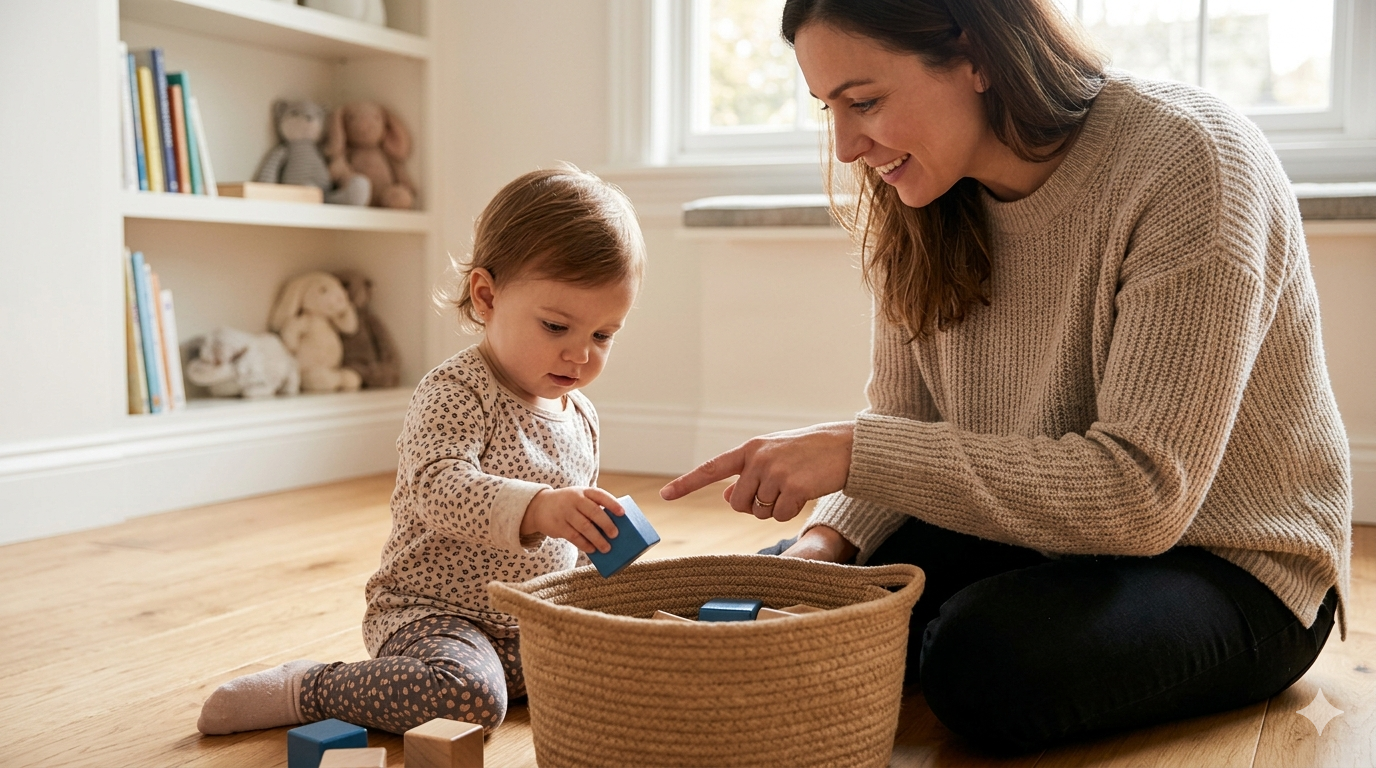
When Should My Toddler Start Following Simple Instructions?
Updated: April 20, 2026 · 6 Minute Read

Reviewed by:
Emily Rourke, OTD, OTR/L
Highlights
- Following instructions is part of a child’s receptive language development
- Understanding instructions builds a strong foundation for later learning, behavior, and social interaction
- Early intervention programs offer free evaluations for children under 3 in most states
- Following simple instructions is a key milestone in your toddler’s language journey
Introduction
One of the most exciting parts of toddlerhood is watching your child begin to understand and respond to what you say. Whether it’s “Come here,” “Clap your hands,” or “Let’s clean up,” these small moments of comprehension are big steps in early development. But when should toddlers start following simple instructions, and what does it mean if they don’t?
In this article, we’ll walk through what to expect at different ages, what types of instructions are appropriate, and how to support your child’s understanding of language—also known as receptive language. We’ll also share red flags to watch for and when to seek help.
1. What Does It Mean to Follow Simple Instructions?
Following instructions is part of a child’s receptive language development. It involves listening, processing what was said, and responding with an action.
Simple instructions are usually:
- Short (one or two steps)
- Familiar (related to daily routines or toys)
- Given with visual cues (pointing, gestures)
- Said in a calm, clear voice
Examples include:
- “Give me the ball”
- “Sit down”
- “Come here”
- “Clap your hands”
- “Pick up the toy and put it in the bin”
Understanding instructions builds a strong foundation for later learning, behavior, and social interaction.
2. When Should Toddlers Start Following Instructions?
By 12 Months
Your baby should begin responding to simple gestures and familiar routines:
- Stops what they’re doing when you say “no”
- Follows simple commands with gestures (e.g., “come here” with arms outstretched)
- Responds to their name
- Looks at the correct object when you say its name
By 18 Months
Your toddler may:
- Follow simple one-step instructions like “give me the toy” or “come here”
- Understand words for common objects and people
- Begin to follow commands without gestures
- Help with simple routines like throwing away a diaper
By 24 Months
Most children can:
- Follow two-step instructions like “get your shoes and bring them here”
- Understand action words (run, sit, jump)
- Follow commands related to body parts (“touch your nose”)
- Understand more abstract concepts like “in,” “on,” or “under”
Every child develops at their own pace, but consistent interaction and modeling can support comprehension.
3. How Can I Help My Toddler Learn to Follow Instructions?
1. Get Their Attention First
Make sure your child is looking at you before giving instructions. You might say their name or gently touch their arm.
2. Keep It Short and Simple
Use one or two words at first (“Come here”), then gradually increase complexity as your child understands more.
3. Pair Words with Gestures
Pointing, nodding, and showing help toddlers connect meaning to words.
4. Use Routines
Daily tasks like mealtime, dressing, and cleanup are full of opportunities to practice following directions.
5. Be Consistent and Repetitive
Repetition helps toddlers learn and predict what comes next.
6. Celebrate Success
Praise or show excitement when your child follows through, even if it’s not perfect.
4. When Should I Be Concerned?
Talk to your pediatrician or an early intervention provider if your child:
- Doesn’t respond to their name by 12 months
- Doesn’t follow simple instructions by 18 months
- Rarely points or uses gestures to communicate
- Seems uninterested in spoken language
- Struggles to understand daily routines
Early intervention programs offer free evaluations for children under 3 in most states. Speech-language pathologists (SLPs) can assess your child’s receptive and expressive language skills and provide strategies to help.
5. Real-Life Examples
- Olivia, 13 months, started turning her head when her name was called and followed “give it to me” when her dad reached for a toy.
- Jackson, 20 months, learned to follow “get your cup” during mealtimes after hearing it often paired with pointing.
- Sofia, 24 months, followed two-step commands like “get your shoes and sit down” with help from daily practice during morning routines.
6. Conclusion
Following simple instructions is a key milestone in your toddler’s language journey. While every child develops at their own pace, most begin understanding and responding to simple commands in their first two years. By using routines, gestures, and repetition, you can help your child build strong listening and comprehension skills that support lifelong learning.\
And remember, if you ever have concerns about your child’s development, trust your instincts. Support is available, and early help can make a big difference.
Find pediatric speech & occupational therapy, covered by insurance.


Article References
- American Speech-Language-Hearing Association. (2023). Receptive Language Disorders.
- Centers for Disease Control and Prevention (CDC). (2023). Learn the Signs. Act Early.
- Zero to Three. (2021). Tips on Helping Toddlers Follow Directions.
- Hanen Centre. (2020). Encouraging Language Development in Young Children.