
How to Attract More Patients With SEO: A Therapist’s Guide
Updated: April 9, 2026 · 10 Minute Read

Written by:
Savanah Farnell
Highlights
- SEO is about clarity and accessibility, making it obvious to both clients and search engines what services you provide and what problems you solve.
- AIO is about making sure your content is structured in a way that allows AI tools to find it, understand it, and use it in those answers.
- SEO is not a one-time task to check off your list. It is an ongoing effort that compounds over time.
Starting your own speech, occupational or physical therapy practice is exciting. Expertise and training got you here, now you want to reach new clients! ! Your first step is building a website, but once you have one you’ll want to make sure your site is showing up for relevant clients. You may have heard terms like SEO, AIO and organic traffic; these terms can sound technical but they are simply tools that help people discover your practice without replying solely on referrals or paid ads.
This guide breaks down these concepts in plain language, explains why they matter, and provides actionable steps you can take right away!
Understanding Organic Traffic
Organic traffic is when people find your website naturally, without paid ads. These are visitors who arrive after searching for relevant terms on Google or another search engine.
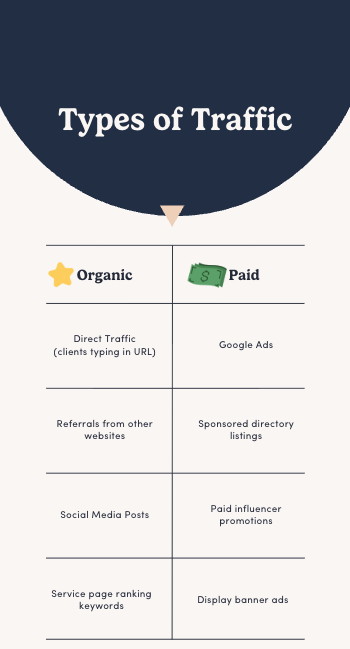
In marketing, there are two categories: “paid traffic” and “organic traffic.” In an ideal world, all of your traffic is organic traffic. The best part about organic traffic is that it’s self-sustaining: unlike paid ads where traffic stops the moment you stop spending, a well-optimized site that generates organic traffic can continue attracting new families for months or years without any ongoing costs.
SEO - Guiding Traffic to your Site
SEO stands for search engine optimization. It is the process of helping search engines understand what your site is all about so that it appears in relevant searches. In practical terms, SEO is about clarity and accessibility, making it obvious to both clients and search engines what services you provide and what problems you solve.
Think of Google as the owner of a massive bookstore. People walk in looking for a very specific book. Maybe they are searching for “speech therapy for toddlers” or “exercises for back pain”. Google doesn’t just hand out books at random, instead it recommends books based on two things:
- The content of the book
- How readable the book is
Google has bots that read through every website and ask: does this actually answer the audience’s question? Is it relevant to what they’re looking for? If the content is solid and helpful, Google knows it deserves a recommendation and will put it higher up on the search results page (the equivalent of putting a book in the window of a bookstore). .
Accessibility matters too! A book that is disorganized, filled with coffee stains, torn pages, and complicated jargon might have great information, but people struggle to get through it. The same applies for your website, Google will notice sites that are disorganized and will be less likely to recommend it to visitors.
Key SEO Practices for Therapists
-
Create Dedicated Pages for Each Service
When Google bots are looking through your site, it should be clear what services you provide. When a service has its own page, Google understands exactly what you offer and potential clients land on information that is directly relevant to them.
Every service you offer should have its own page with a descriptive title and clear headings. Use page titles that match what clients actually type into search engines. Avoid generic labels like ‘Services”.
Examples:
“Speech Therapy for Toddlers”
“Pediatric Feeding Therapy”
“Sensory Integration OT”
There’s a couple ways to organize these pages on your site. For one option, they could be in a sub-menu under “Services” at the top of your site.(Your top ribbon might read:: Home, About, Services, Contact; where "Services" might drop down to show "Feeding Therapy," "Early Intervention," "Sensory Integration," etc.). Alternatively, you might list them directly in your top ribbon (Home, About, Feeding Therapy, Early Intervention, Contact). Even if you're not ready to build out a full page for every service, start with at least one or two of your most common specialties, and make sure that each one has its own dedicated URL like "yourwebsite.com/feedingtherapy."
-
Speak the Client’s Language
Use client friendly language throughout your website. Clinical terminology should be translated into words clients are likely to actually search for.
As a speech therapist, most parents have never heard of an “expressive language delay”. Instead lead with phrases like “my toddler isn’t talking yet” to introduce your language services. As occupational therapists, parents are more likely to search "difficulty /holding a pencil” than “fine motor deficits”.
A helpful exercise: write down the most common questions and concerns clients bring to you. Those exact words and phrases belong on your website.
-
Answer Commonly Asked Questions
A major part of SEO is value. The more valuable information on your website, including answered questions, appear on your website, the more valuable Google considers it and the higher it will rank. Create a frequently asked questions page or embed frequently asked questions within your home page. Even five well-written answers can make a meaningful difference.
Location Keywords: Building a Local Reputation
For a potential client in your city to find you, your website needs to signal that you serve that area. This means weaving your city or region into your website content in a way that reads naturally.
Here’s a few ideas on how you can weave in your location without it sounding forced or unnatural:
- Mention your city where it fits. For example, “I provide speech therapy to families throughout San Diego and surrounding communities” or “serving children and adults in Annapolis, MD”. These kinds of sentences send local signals to search engines and affirms potential clients at the same time.
- Avoid over doing it. A few natural mentions per page is all you need for Google to understand. Too many repetitions and Google may think your content looks ‘spammy’ or unclear. Write as if you are speaking to a potential client and the keywords will fall in naturally.
The New SEO: How to Use AI to Your Advantage
AIO or Artificial intelligence Optimization is the next layer of visibility to consider. While SEO helps your website appear in traditional search results, AIO helps your content show up in AI-generated answers (think ChatGPT or Claude).
Over 800-million people use AI-powered search tools monthly, and nearly 25-30% of all searches now involve an AI-generated component whether that is a summary, a direct answer or a recommendation. According to AI search statistics for 2026, an estimated 35% of users have started using AI-tools instead of traditional search engines and the number is growing.
When someone asks a question in ChatGPT or uses Google’s AI-generated results, they often receive a direct answer instead of a list of links. Those answers are assembled by pulling content from across the internet. AIO is about making sure your content is structured in a way that allows AI tools to find it, understand it, and use it in those answers.
AI tools tend to favor content that is:
- Clear and easy to understand
- Organized with headers and a logical flow
- Directly answers a specific question
This mirrors exactly what makes your content effective for SEO. The key difference is that AI often pulls short, concise explanations, so clarity is especially important.
Five ways to Optimize Your Content for AI
- Write in a question and answer format. AI is always looking for direct answers. It is important to structure your content around the questions your clients are already asking. Your FAQ section is a great place to do this, but you can also frame your service descriptions the same way. Instead of “I offer language therapy for children" consider opening with “Is your child struggling to find the right words?” and answering directly from there to highlight your services.

Website Mockup Example
Copywriting/Design by Savanah Farnell
- Keep explanations concise and direct. Long paragraphs are difficult for AI to process and extract information from. Short, focused explanations are better. Aim to answer a question clearly within the first few sentences of each section, and use bullet points or numbered lists wherever you can.
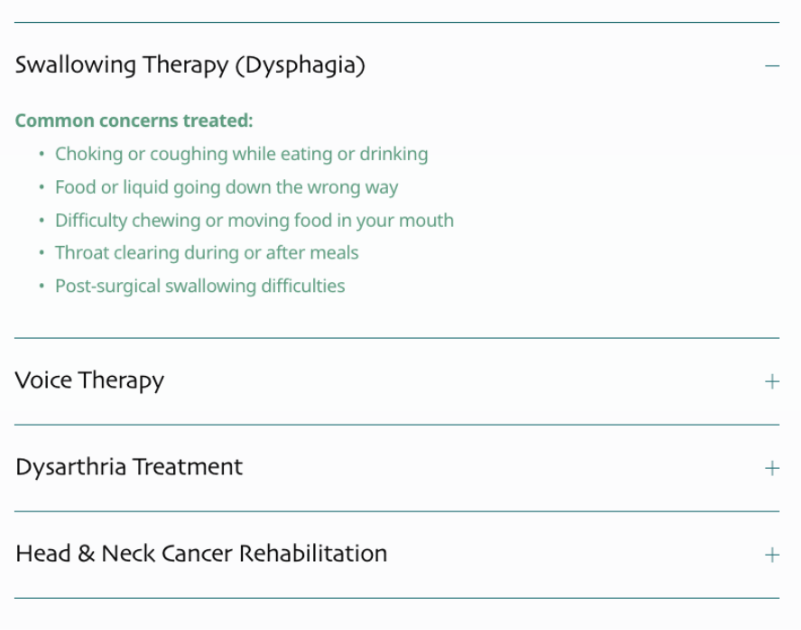
Website: Mend Head and Neck Rehab
Copywriting/Design by Savanah Farnell
- Use clear headers that match your questions. Your headers should reflect the questions your clients are searching for in search search engines and AI tools. A header like “What Are The Signs A Toddler Might Need Speech Therapy?” is more likely to be picked up by AI than a vague header like “Our Approach”.

Website Mockup & Copywriting by Savanah Farnell
- Specify your niche. The more clearly you define who you serve and what you specialized in, the more likely AI tools are to surface your content for the right searches. A therapist who specializes in pediatric feeding therapy will rank higher for those searches far more effectively than one whose content describes a broad range of services.
- Build real-world credibility. AI tools, similar to search engines, favor content from sources that demonstrate genuine expertise and trust. Display your credentials, link your Beaming Health profile, ask for reviews and be consistent across all directories. The more signals across the internet that confirm you are a real, qualified provider in a specific location, the more likely AI tools are to include you in their answers.
Beyond your Website: Optimizing Your Practice with a Google My Business Profile
If a client leads searches ‘speech therapist near me”, the very first result might be a map, populated with Google Business Profile listings. This is where your name, location, hours, reviews and contact details appear directly in search results. For therapists just starting out, your Google Business Profile is often found before your website.
An important part of your Google Business Profile is getting client reviews. Reviews are one of the most powerful signals of trust for both local SEO and potential clients. Google favors businesses with recent and consistent reviews. A steady stream of genuine feedback builds credibility and reassures families that they are in the right place.
One strategy for collecting feedback or reviews is to build it into your workflow. When a client reaches a milestone or completes their therapy journey, that is a natural moment to schedule a thank-you/follow-up with a review request. Send a simple, generic message. For example:
“Hi, it has been a pleasure working with you! If you would like to share a few words about your experience, here is a link to leave a Google review. Your feedback helps other families find the support they need.”
Remember to always reply to reviews. When a review comes in, respond to each one, even if briefly. Responding to a review shows you value feedback and can positively impact your local profile ranking. If a less-than-perfect review arrives, respond politely and address the concern. A thoughtful replay can turn the situation around entirely.
Putting It All Together
SEO is not a one-time task to check off your list. It is an ongoing effort that compounds over time. A simple monthly routine can make a big difference. On your website, this could mean making small changes like updating years of experience or sharing a testimonial from a parent. Something that tells Google, “this site has new information on it!” On your Google My Business Profile, this could look like responding to any new reviews, posting a photo, or checking that your contact details are accurate everywhere they appear online.
Remember that most of these steps don’t require a ton of technical knowledge or time, they just require consistency. Start with your website structure and your Google business Profile , then work through the rest at a pace that feels right for you. Over time, these efforts will make it increasingly easy for the right clients to find you!
Find pediatric speech & occupational therapy, covered by insurance.